 Tampa Siding
 Siding in Town 'n' Country: A Different Kind of Wear
Town 'n' Country sits in unincorporated Hillsborough County, west of downtown Tampa and close enough to Tampa Bay that salt-tinged air is part of daily life. The neighborhood's housing stock spans decades of Florida construction, from older ranch-style homes to newer infill builds, and a lot of that inventory is now reaching the point where original siding — or a prior replacement — is showing its age. Siding here doesn't fail because homeowners neglect it. It fails because the material wasn't built for this specific combination of stresses: constant UV load, humidity that rarely lets up, wind-driven rain that gets pushed sideways during storms, and salt air drifting in off the bay that slowly works on anything not engineered to resist it.
We install siding across the Tampa area, and Town 'n' Country's mix of home ages means we see the full range of siding failure modes in one neighborhood: sun-bleached and chalky vinyl, swollen and delaminating wood-based panels, cracked caulk joints letting moisture behind the cladding, and in some cases siding that was never matched to Florida's climate in the first place. Replacing siding here isn't just a cosmetic upgrade — it's a chance to put a product on the house that's actually engineered for what this region throws at it.
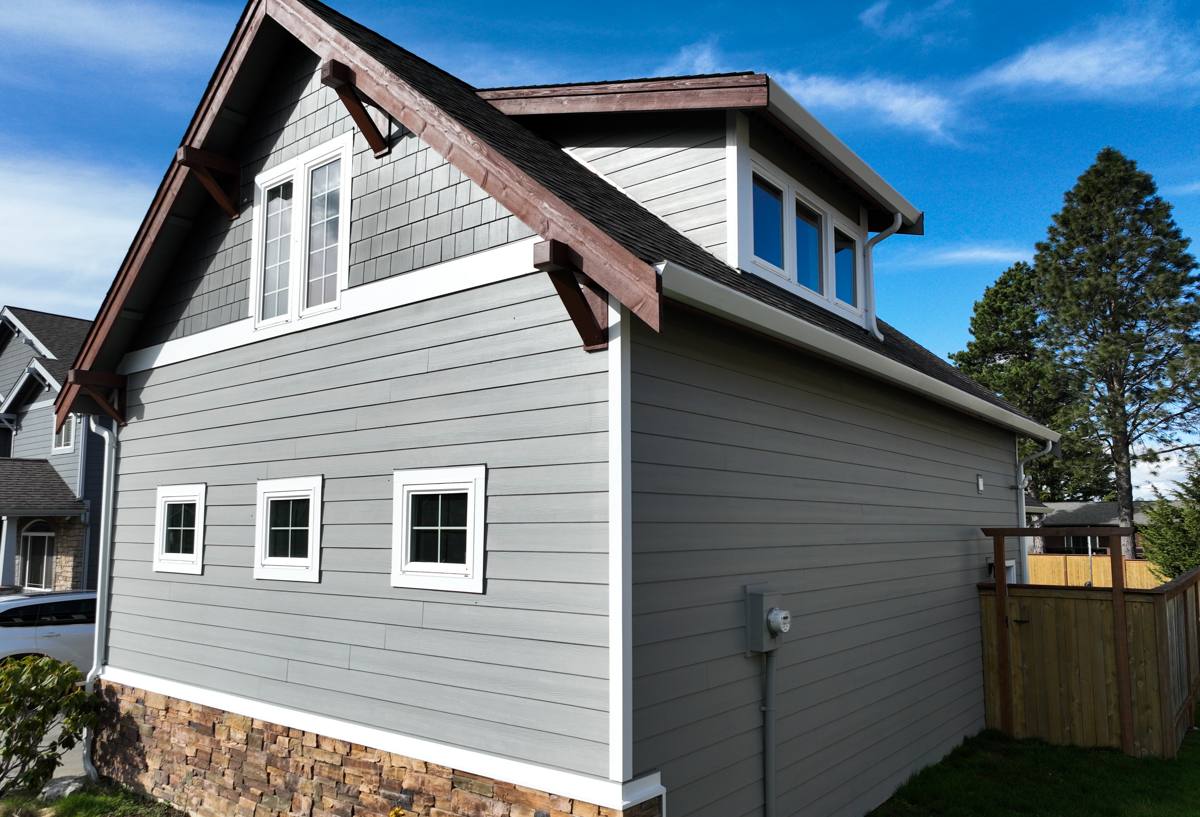
What Hillsborough County Weather Does to Siding
Four climate factors drive siding decisions in Town 'n' Country, and they don't act alone — they compound each other.
Hurricane-Force Wind
Tampa Bay's exposure means Town 'n' Country homes need to be built to withstand real wind loads, not just steady breezes. Siding that isn't rated or installed for high-wind conditions can lift, crack at fastener points, or blow off entirely during a named storm, exposing the wall assembly underneath.
Intense, Year-Round UV
Florida's sun angle and long daylight hours mean siding here takes a UV beating every month of the year, not just in summer. Cheaper coatings chalk, fade, and become brittle years before their rated lifespan. Color consistency — especially on the sun-facing side of a house — is one of the first places lower-grade siding shows its age.
Wind-Driven Rain
It's not just how much rain falls, it's how it arrives. Storms here regularly push rain sideways into wall assemblies, which means siding has to actually shed water at the seams and laps, not just tolerate a light drizzle. Poor installation detail — gaps, under-caulked joints, missing flashing — turns wind-driven rain into a moisture problem behind the siding, where it's much harder to catch early.
Salt Air
Town 'n' Country isn't waterfront, but it's close enough to Tampa Bay that salt-laden air is a real factor, especially on days with onshore wind. Salt exposure accelerates corrosion on fasteners and trim, and it can degrade certain coatings and composite materials faster than inland climates would.
None of these forces is unusual for the Tampa area on its own. What matters is that Town 'n' Country homes deal with all four, continuously, which is why we're selective about what we'll put on a wall here.
Why We Install Only James Hardie Fiber Cement
Our company made a deliberate decision years ago to install one siding system: James Hardie fiber cement. We don't offer vinyl, LP SmartSide, Cemplank, Allura, primed spruce, or cedar as options — not because those products don't have a place in the market somewhere, but because we don't think they hold up to Hillsborough County's climate the way homeowners deserve, and we'd rather stand behind one product we trust completely than offer a menu of compromises.
Here's the honest reasoning:
- Non-combustible material. Fiber cement is composed largely of sand, cement, and cellulose fiber, giving it a level of fire resistance that wood-based and vinyl products can't match.
- Engineered for humid, high-heat, high-moisture climates. James Hardie makes climate-specific HZ5 product formulations designed around exactly the conditions we deal with in West Florida — humidity, heat, and moisture cycling.
- Factory-applied ColorPlus finish. Instead of field-applied paint that starts degrading the moment it's exposed to Florida sun, ColorPlus color is baked on in a controlled factory process, which holds color and resists fading, chipping, and cracking far longer than typical field-painted finishes.
- Dimensionally stable. Fiber cement doesn't swell, warp, or rot the way wood-based composite siding can when it takes on moisture — a real issue in a climate where humidity rarely drops.
- A warranty structure built around long-term ownership. James Hardie's transferable limited warranty is written for a product meant to last on the house, not just through the next few Florida summers.
We're not going to tell you other siding products are junk — plenty of them are reasonable choices in the right climate, installed the right way. What we will say is that after years of doing exterior work in this region, we don't think vinyl, engineered wood, or unfinished wood siding are the right long-term bet for a Town 'n' Country roof line, and we'd rather turn down a job than install something we don't believe in.
How Siding Products Compare in This Climate
| Factor | James Hardie Fiber Cement | Vinyl | LP SmartSide / Engineered Wood | Unfinished Wood (Cedar, Spruce) |
|---|---|---|---|---|
| Heat & UV resistance | Factory ColorPlus finish resists fading | Can warp and fade in direct, sustained heat | Coating wears; needs repainting over time | Requires regular refinishing to resist sun damage |
| Moisture behavior | Dimensionally stable, engineered for humidity | Doesn't absorb moisture but can trap it behind panels | Prone to swelling/delamination if moisture gets in | Absorbs moisture; rot risk without diligent upkeep |
| Wind performance | Rated systems built for high-wind installation | Lighter panels more prone to wind damage | Performance varies by product and install quality | Depends heavily on fastening and board condition |
| Fire resistance | Non-combustible core material | Combustible, can melt or deform near heat | Combustible wood-based core | Combustible |
| Maintenance | Low — occasional wash, caulk checks | Low, but degrades rather than being repaired | Moderate — coating and moisture checks | High — regular sealing/painting required |
What a James Hardie Siding Replacement Involves
Replacing siding correctly is as much about what's happening behind the panels as the panels themselves. Our process for Town 'n' Country homes generally includes:
- Tear-off and inspection. We remove the old siding and inspect the sheathing and framing underneath for hidden moisture damage, which is common in this climate even when the exterior looked fine.
- Repair before cover-up. Any soft, rotted, or water-damaged sheathing gets addressed before anything new goes up — covering a compromised wall with beautiful new siding just hides the problem.
- Weather-resistive barrier. A proper house wrap or building paper goes down to manage bulk water and give the wall assembly a second line of defense against wind-driven rain.
- Correct flashing and fastening. Windows, doors, and penetrations get flashed to shed water outward, and Hardie panels are fastened according to manufacturer spec for our wind zone — this is where a lot of installation shortcuts show up years later.
- ColorPlus panel installation. Panels, trim, and accessories go up with correct gapping and caulking at seams, which matters enormously for keeping wind-driven rain out of the wall.
- Final inspection and cleanup. We walk the finished exterior, check caulk lines and trim details, and clear the site.
Signs It's Time to Replace, Not Repair
- Visible cracking, buckling, or warping across multiple sections of siding
- Soft or spongy spots when pressed, indicating moisture behind the surface
- Persistent chalking or fading that pressure washing doesn't improve
- Gaps opening at seams, corners, or around windows and doors
- Rising energy bills that suggest the wall assembly is no longer performing
- Repeated localized repairs that keep recurring in the same areas
A Local Crew Matters More Than People Realize
Siding installation is unforgiving of shortcuts, and Florida's climate exposes bad installation faster than milder regions do. A crew that works Hillsborough County roofs and walls regularly knows how local wind exposure, humidity, and storm patterns should shape fastening schedules, flashing details, and product selection — knowledge that's hard to substitute with a generic installation approach. We also handle roofing, windows, and decks, which matters on a siding job because these systems meet at critical points: roofline flashing, window and door transitions, and deck ledger connections. Getting those intersections right is part of what keeps water out of a house long-term.
Beyond Siding: The Full Exterior Picture
Homeowners in Town 'n' Country often come to us about siding and end up asking about the rest of the exterior, because the same climate stress hitting the walls is hitting the roof, windows, and any outdoor decking. A siding replacement is a natural point to have a broader conversation:
- Roofing — the roofline and siding meet at flashing points that need to work together to shed wind-driven rain.
- Windows — old or poorly sealed windows are a common source of the moisture intrusion we find when we open up a wall.
- Decks — exterior decking faces the same UV and moisture cycling as siding and often needs attention around the same time.
We don't push unnecessary work, but if we see something during a siding job that's likely to cause problems down the line, we'll tell you directly.
What Affects Siding Replacement Cost
Every home is different, but the factors that most commonly move the price on a Town 'n' Country siding job include:
| Cost Factor | Why It Matters |
|---|---|
| Home size and wall complexity | More square footage and more corners, dormers, or gables mean more material and labor |
| Condition of the sheathing underneath | Hidden moisture damage found during tear-off adds repair scope before new siding goes up |
| Siding profile and trim selection | Lap width, trim style, and accent details affect material cost |
| ColorPlus color selection | Factory-finished color options vary in cost versus standard primed panels |
| Access and site conditions | Landscaping, fencing, or tight lot lines can add labor time |
We provide a written, itemized estimate before any work begins, so there are no surprises once the project is underway.
Get a Straightforward Estimate
If your Town 'n' Country home's siding is fading, cracking, or letting moisture in, it's worth having a local crew take a real look before the next storm season adds to the problem. We'll walk the exterior with you, explain what we're seeing, and give you a clear, no-pressure estimate for a James Hardie fiber cement replacement built for what this part of Hillsborough County actually deals with. Use the form below to request your free estimate.